




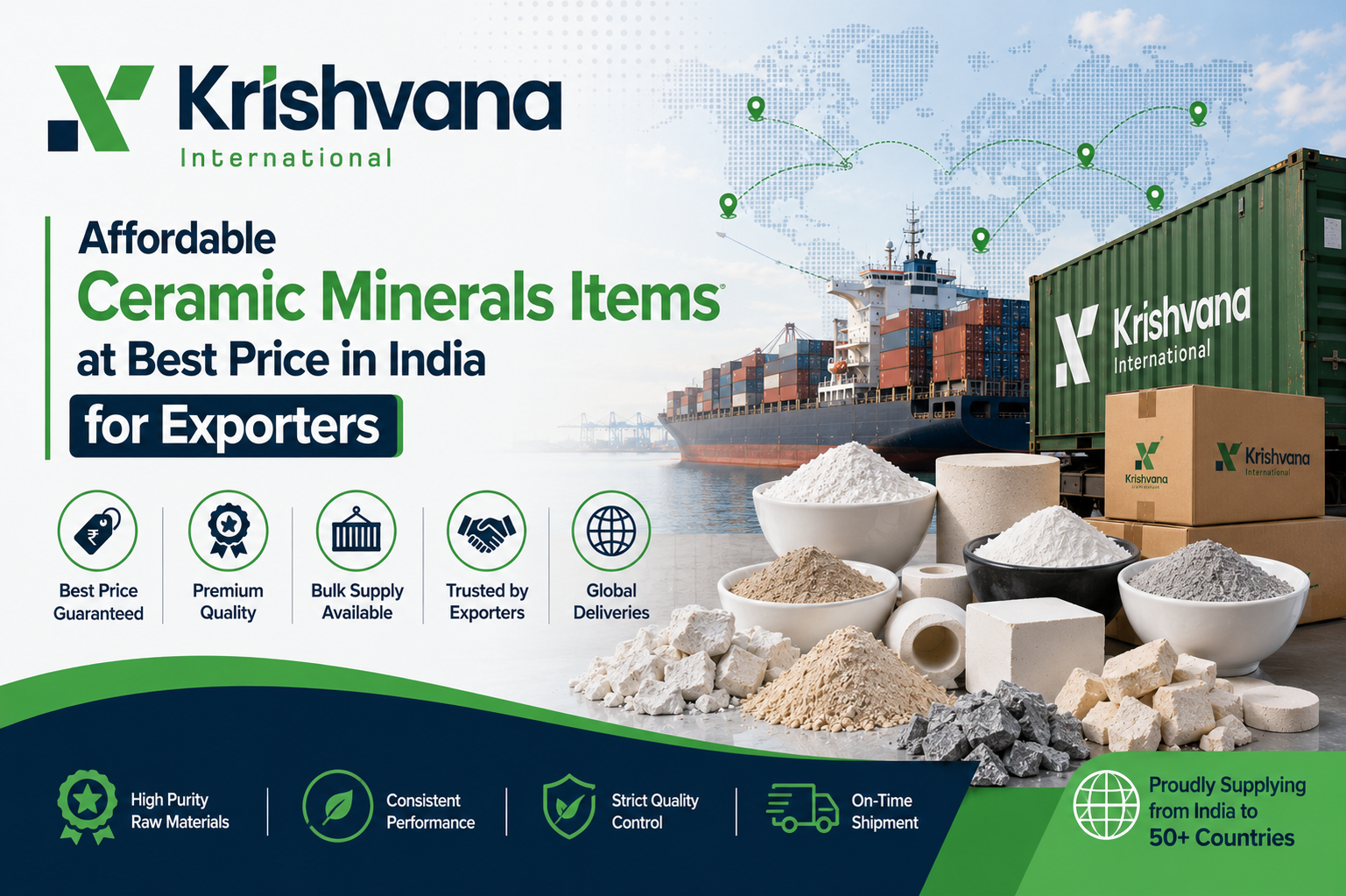
India has become one of the world’s largest suppliers of high-quality ceramic mineral items to ceramic manufacturers, exporters, and industrial buyers. In response to an increase in demand for durable ceramic products on the international market, many exporters are seeking affordable, high-quality mineral solutions to increase the quality of their production while maintaining competitive prices.
There is a great deal of dependence on reliable ceramic raw materials in the ceramic industry, since these materials directly impact the strength, finish, durability, heat resistance, and overall performance of their products. Due to its wide variety of industrial minerals, advanced processing technology, and cost-effective manufacturing solutions, India is a popular destination for exporters.
Different minerals used in ceramics play a significant role in the quality of ceramic products. A wide range of ceramic and porcelain products are included in this category, including wall tiles, sanitary ware, and industrial ceramics. A variety of minerals are used to manufacture ceramics, including quartz, feldspar, silica, kaolin, and clay. A growing demand for advanced ceramic materials has also increased the need for suppliers who can offer consistent quality, export-ready packaging, and bulk supply services. Many global buyers prefer Ceramic Mineral Items manufactured by Indian manufacturers due to their affordable prices and reliable supply chains.
It is explained in this guide why India is a preferred destination for ceramic mineral exports. As well as explaining the importance of quality minerals, the article also outlines how exporters can identify and select the right supplier in order to achieve long-term success.
Why are ceramic minerals important in ceramic manufacturing?
The Foundation of High-Quality Ceramic Products
Without high-quality Ceramic Minerals Items, the ceramic industry would not be able to function. It is these minerals that impart structural strength, thermal resistance, durability, and a smooth surface finish to ceramic products. Whether manufacturing floor tiles, sanitary ware, tableware, or industrial ceramics, its quality directly affects the final output.
Modern ceramic manufacturers focus heavily on maintaining excellent ceramic quality because global buyers demand durable and visually appealing products. This is why selecting the right mineral combination becomes critical during production.
Common Minerals Used in Ceramic Production
Quartz
A wide variety of ceramics are made from quartz due to its improved hardness, durability, and thermal stability. During the firing process, quartz also controls shrinkage.
Granite
Further, it reduces the melting temperature and improves the vitrification process in addition to serving as a fluxing material.
Kaolin Clay
Plasticity and whiteness are provided by ceramic products.
Silica
Improves the strength and heat resistance of industrial ceramics.
Ceramic manufacturers can achieve consistent product performance while reducing production errors by using industrial minerals.
Benefits of Premium Ceramic Minerals
- Improved product durability
- Better thermal resistance
- Improved surface finish
- Reduce manufacturing defects
- High export quality standards
By using high-quality ceramic mineral items, exporters can also meet international ceramic manufacturing standards.
Why is India a Global Hub for Ceramic and Mineral Exports?
Strong Manufacturing and Mineral Availability
There is no doubt that India has a wealth of industrial minerals and an internationally recognized ceramic manufacturing infrastructure. Mineral processing and ceramics have become major industrial sectors in Gujarati regions such as Morbi.
The increasing demand for Ceramic Minerals at the best price in Morbi, Gujarat, is an indication of the region’s growing importance in international ceramic exports. Indian minerals are imported by exporters around the world due to their affordable prices, consistent quality, and large production capacity.
Reasons Exporters Prefer Indian Suppliers
Cost-Effective Pricing
A wide range of Ceramic Minerals Items is available from Indian suppliers at an affordable price without sacrificing quality.
Bulk Export Capability
Manufacturers can efficiently handle large export orders with proper packaging and logistics support.
Advanced Processing Technology
Modern processing plants ensure mineral purity and consistency.
Global Supply Support
Shipping solutions are offered by Indian exporters worldwide, as well as custom supply solutions.
There is also a growing international demand for Top Minerals For Ceramic Manufacturing due to the country’s strong ceramic ecosystem.
Growing Demand for Advanced Ceramics
Advanced ceramics have increased the need for highly refined mineral materials. Industries need minerals like:
- High thermal resistance
- Precise chemical composition
- Better mechanical strength
- Improved purity levels
Indian suppliers will continue to invest in advanced manufacturing technology to meet the demands of the global industrial market as a result.
What is the benefit of ceramic minerals for product quality?
The Role of Minerals in Ceramic Performance
Minerals used in the manufacture of ceramic products play a significant role in determining the quality and composition of the product. A ceramic mineral item improves both the appearance and durability of the product as well as its industrial performance.
Due to the fact that international buyers expect consistent standards and long-lasting products, manufacturers that target export markets place a high value on superior ceramic quality.
Key Performance Benefits
Better Heat Resistance
Minerals such as quartz and silica improve ceramic thermal stability.
Enhancing Product Strength
High-quality minerals reduce breakage and improve durability.
Improved Surface Finish
Refined mineral processing creates smoother and prettier ceramic surfaces.
Reduced Manufacturing Waste
Consistent mineral composition minimizes cracks and firing defects.
Ceramic raw materials are carefully selected by industries based on their applications and production objectives.
Importance of Quartz in Ceramic Manufacturing
Among all the minerals used in ceramics, quartz plays one of the most important roles. Quartz in ceramics helps maintain structural stability during the heating and firing processes.
Advantages of Quartz
- Increases the hardness
- Reduces shrinkage
- Improves thermal resistance
- Enhances product durability
Exporters often choose ceramic mineral items made of quartz-based materials because they enhance overall product quality.
Factors Exporters Should Consider Before Choosing Suppliers
Quality Standards and Product Consistency
Exporters must carefully evaluate mineral suppliers before making long-term purchasing decisions. Low-quality minerals can cause production efficiency to be reduced, waste to increase, and export reputations to be damaged.
A supplier with strict quality control standards should be chosen for the supply of Ceramic Minerals’ Items.
Important Factors to Check
Mineral Purity
The higher the purity, the better the ceramic performance and the fewer manufacturing defects there are.
Particle Size Consistency
Uniform particle size improves production efficiency.
Moisture Control
The management of moisture during processing enhances the stability of the material.
Bulk Supply Capacity
Exporters need suppliers capable of handling large quantities of orders.
It is also important to identify suppliers who provide technical support regarding Industrial Minerals in Ceramics and the appropriate mineral combinations for different products.
Pricing and Export Support
Price remains one of exporters’ biggest concerns. It is, however, recommended that buyers choose suppliers who offer the best value rather than those who are the cheapest.
Ceramic Minerals Items from a trustworthy supplier should include the following:
- Competitive export pricing
- Bulk order discounts
- Export-grade packaging
- Fast logistics support
- Long-term supply reliability
There is a high demand for ceramic minerals in Morbi, Gujarat by many international buyers, as suppliers provide both affordable prices and high quality ceramic minerals.
Growing Demand for Advanced Ceramic Materials on the Global Markets
Expansion into Industrial Ceramics Applications
Ceramic materials are used in a wide range of industries, including construction, electronics, automotive, healthcare, and aerospace. Industrial sectors require ceramic products with high strength, wear resistance, and thermal stability.
Ceramic and mineral products are in high demand, which has resulted in an increase in the importance of industrial manufacturing.
Industries Driving Ceramic Mineral Demand
Construction Industry
Use ceramic tiles, sanitary ware, and decorative products.
Electronics Industry
Requires heat-resistant ceramic components.
Automotive Industry
Use ceramics for insulation and high-temperature applications.
Medical Industry
Advanced ceramics are used in dental and orthopedic applications.
Demand for high-purity advanced ceramic manufacturing materials has also increased due to industrial applications.
The Importance of Sustainable Mineral Sourcing
Global buyers now prefer environmentally responsible sourcing practices. Reliable suppliers focus on:
- Sustainable mining methods
- Waste reduction systems
- Energy-efficient processing
- Eco-friendly packaging
Exporters and suppliers of ceramic minerals benefit from these practices because they enhance their global competitiveness.
Why Long-Term Supplier Partnerships Matter for Exporters?
Benefits of Working with Trusted Suppliers
The benefits of long-term partnerships are realized by exporters when stable production quality and uninterrupted business operations are maintained. A reliable supplier of Ceramic Mineral Items will ensure product quality and timely delivery.
Advantages of Long-Term Supply Agreements
Stable Pricing
Long-term contracts help exporters avoid sudden price fluctuations.
Consistent Product Quality
Reliable suppliers maintain uniform mineral specifications.
Priority Production Support
Regular buyers often receive faster processing and dispatch.
Better Export Planning
Consistent supply improves production scheduling and inventory management.
Professional suppliers also provide exporters with information about market trends, new mineral technologies, and changing requirements for industrial applications.
Importance of Gujarat in Ceramic and Mineral Exports
Gujarat has emerged as India’s leading ceramic production hub. A global demand for ceramic minerals at the best prices has been demonstrated in Morbi, Gujarat, which is a testament to the region’s strong export infrastructure and mineral processing expertise.
Suppliers from Gujarat are known for:
- Large-scale production
- Affordable prices
- High quality minerals
- Global export support
- Strong logistics networks
India is one of the world’s most trusted ceramic minerals suppliers.
Conclusion
As a global supplier of high-quality Ceramic Minerals Items, India continues to strengthen its position as a leading player. India’s ceramic raw material suppliers are able to meet the international demand for ceramic raw materials because of its abundant mineral resources, advanced processing technology, affordable prices, and strong export capabilities.
Material properties such as durability, appearance, and industrial performance are directly affected by ceramic raw materials. This is why exporters should carefully select reliable suppliers offering consistent mineral quality, technical expertise, and long-term supply support.
Ceramic Minerals Items, including quartz, silica, and advanced industrial minerals, enable manufacturers to produce high-quality ceramic products and improve operational efficiency.
Global demand for advanced ceramic materials and industrial ceramics is rising. Partnering with an Indian supplier ensures better quality, competitive pricing, and sustainable growth for your business.
FAQs
1. What are Ceramic Minerals Items?
Ceramic Minerals Items are industrial minerals such as quartz, feldspar, silica, and clay used in ceramic manufacturing processes.
2. Why are ceramic minerals important in manufacturing?
These minerals improve product strength, heat resistance, durability, and overall ceramic quality.
3. Why is quartz widely used in ceramics?
Quartz in ceramics improves hardness, thermal stability, and reduces shrinkage during firing processes.
4. Why do exporters prefer Indian ceramic and mineral suppliers?
India offers affordable prices, high-quality minerals, advanced manufacturing facilities, and strong export support.
5. Which industry uses advanced ceramic materials?
Industries such as construction, electronics, automotive, healthcare, and aerospace widely use advanced ceramic materials.
6. Why is Morbi, Gujarat, famous for its ceramic minerals?
Morbi is one of India’s largest ceramic manufacturing hubs, known for producing and exporting high-quality ceramic mineral items at competitive prices.
