




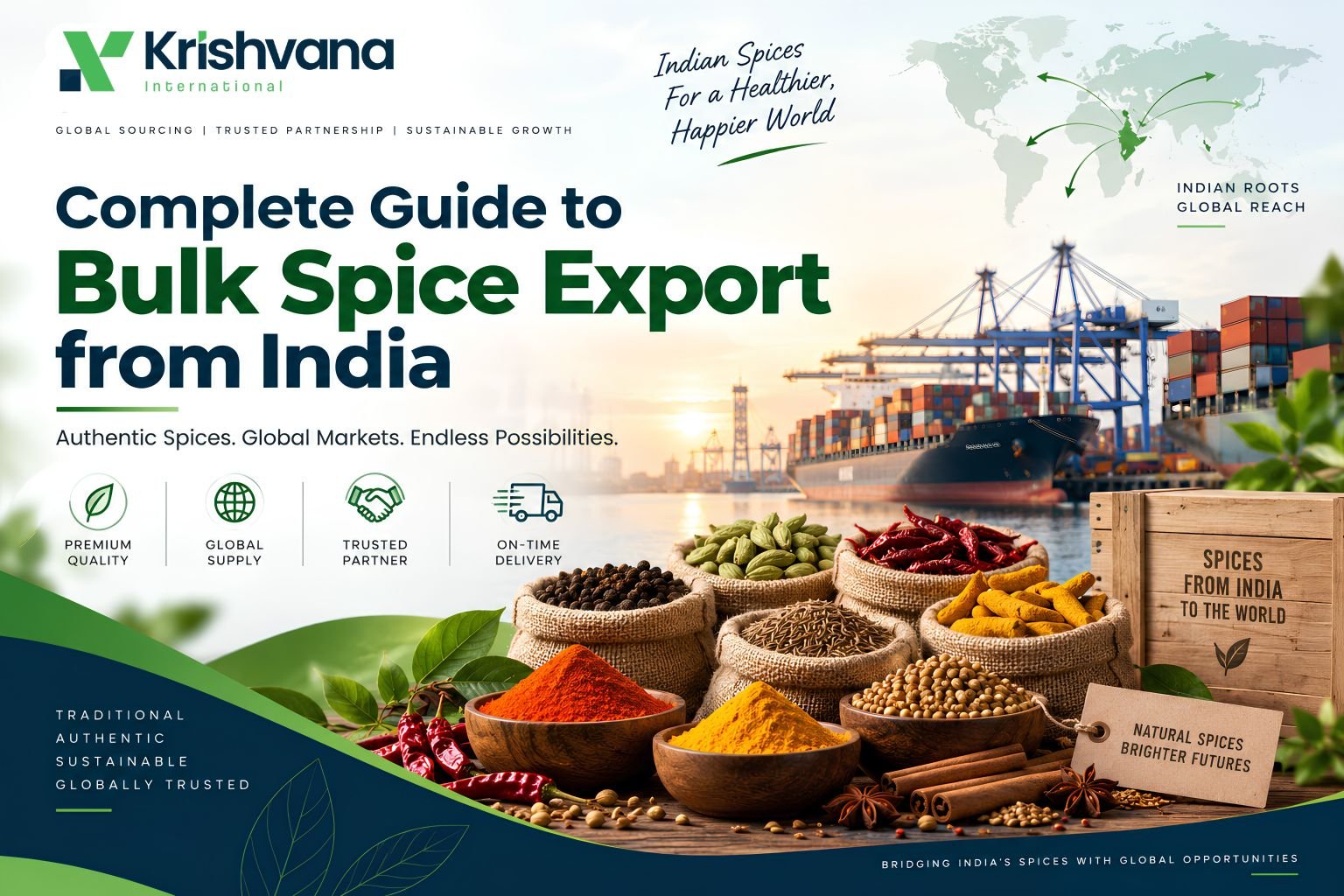
India has long been one of the world’s most important sources of spices, supplying whole spices, ground spices, spice blends, and value-added spice products to international markets. For importers, wholesalers, distributors, food manufacturers, and private-label businesses, sourcing spices in bulk from India can provide access to a broad product range and established agricultural supply chains.
India exported 17.34 lakh tones of spices and spice products valued at approximately US$4.43 billion during FY 2025–26, according to the Spices Board of India. Major contributors included chilli, cumin, spice oils and oleoresins, small cardamom, mint products, turmeric, and curry powder/paste.
However, successful bulk spice sourcing involves more than finding a supplier and negotiating a price. Buyers need to consider product specifications, quality testing, food-safety requirements, packaging, documentation, shipping terms, destination-country regulations, and supplier reliability.
This guide explains the key aspects of bulk spice export from India and what international buyers should consider before placing an order.
What Is Bulk Spice Export from India?
Bulk spice export refers to supplying spices in commercial quantities rather than consumer-sized retail packs.
Depending on the product and buyer’s requirements, bulk spices may be supplied as:
- Whole spices
- Dry fruits, Nuts & Seeds
- Crushed spices
- Ground or powdered spices
- Dried spices
- Spice blends and seasonings
- Processed or value-added spice products
Bulk purchasing is commonly used by:
- Food manufacturers
- Spice processors
- Importers
- Wholesale distributors
- Restaurant and foodservice suppliers
- Retail brands
- Private-label businesses
- Seasoning and ingredient manufacturers
Exact specifications, packaging, quantity, and documentation depend on the product and destination market.
Why Source Spices from India?
India offers international buyers access to a diverse range of bulk spice varieties and established production and export capabilities.
Indian spices are used across food manufacturing, packaged foods, seasoning blends, sauces, ready-to-cook products, restaurants, and traditional cuisines.
For commercial buyers, sourcing from India can provide several advantages:
Wide Product Selection
International buyers can source products such as:
- Cumin seeds and cumin powder
- Coriander seeds and coriander powder
- Turmeric powder
- Red chilli powder
- Kashmiri chilli powder
- Cardamom
- Fennel seeds
- Mustard seeds
- Black salt
- Garlic powder
- Other spices and seasonings
Krishvana International’s current spices and seasonings range includes several of these products for international sourcing.
Established Export Ecosystem
India has a mature spice-export ecosystem supported by growers, processors, exporters, testing facilities, logistics providers, and the Bulk Spices Board.
The Spices Board is responsible for export promotion of spices and also supports quality evaluation and certification activities for spice exports.
Multiple International Markets
India’s spice exports serve markets across North America, the Middle East, Asia, Europe, and other regions.
For FY 2025–26, the Spices Board identified the United States, China, UAE, Bangladesh, Saudi Arabia, the UK, Thailand, Malaysia, Indonesia, Sri Lanka, Germany, the Netherlands, Canada, Nepal, and Australia among major destinations.
Which Spices Can Be Exported in Bulk from India?
The right product depends on the buyer’s market, application, required specification, and import regulations.
Some commonly traded categories include:
1. Cumin
Cumin seeds and cumin powder are widely used in spice blends, sauces, processed foods, snacks, and traditional cuisines.
India’s cumin exports represent a significant portion of the country’s spice export value. The Spices Board reported cumin at approximately 12% of the bulk spice export basket by value in FY 2025–26.
2. Turmeric
Turmeric is supplied primarily as whole dried turmeric or powder and is used in food products, seasoning blends, and various processed-food applications.
3. Coriander
Coriander is available in both seed and powdered forms. It is commonly used in spice blends, sauces, marinades, curries, and processed foods.
4. Chilli
Chilli may be supplied whole, crushed, or powdered, depending on the buyer’s application.
Specifications can vary significantly according to colour, heat level, moisture, cleanliness, and destination-market requirements.
5. Cardamom
Cardamom is a high-value spice used in food, beverages, confectionery, bakery products, and traditional cuisines.
6. Fennel
Fennel seeds and processed fennel products are used in food processing, seasoning, confectionery, and culinary applications.
7. Other Spices and Seasonings
Depending on the exporter’s product portfolio, buyers may also source mustard seeds, garlic powder, black salt, spice blends, and other ingredients.
How to Choose a Bulk Spice Supplier in India
Choosing the right supplier is one of the most important parts of international bulk spice sourcing.
A competitive price alone should not determine the supplier.
International buyers should evaluate:
Product Specifications
Ask the supplier for detailed specifications covering relevant parameters such as:
- Product form
- Purity
- Moisture
- Colour
- Mesh size for powders
- Foreign matter
- Microbiological parameters
- Pesticide residue requirements
- Aflatoxin requirements where applicable
- Other destination-specific testing requirements
Specifications should be agreed before the order is confirmed.
Quality Testing
Food-safety requirements can differ by spice and destination.
The Spices Board operates mandatory sampling and testing requirements for selected bulk spice consignments and destinations based on importing-country requirements.
For example, certain spice products exported to the EU and UK can be subject to specific testing and certification requirements. Current Spices Board notifications should therefore be checked for the product and destination involved.
Export Documentation Capability
A reliable supplier should understand the documentation required for the shipment and coordinate with the buyer and logistics partners.
Depending on the transaction, documentation may include commercial invoices, packing lists, shipping documents, certificates of origin, inspection or test certificates, and other documents required by the importing country.
The exact documentation depends on the product, destination, buyer requirements, and applicable regulations.
Packaging Capability
Bulk spices need packaging suitable for international transportation and the product itself.
Buyers should discuss:
- Packaging material
- Bag or sack size
- Inner liner requirements
- Product protection
- Labelling
- Batch identification
- Storage requirements
- Container loading
What Certifications and Registrations Are Important for Spice Export from India?
Export compliance depends on the product and destination, but several registrations and certifications can be relevant.
Importer Exporter Code (IEC)
Businesses undertaking import or export activities generally require an Importer Exporter Code issued through DGFT, subject to applicable exemptions. DGFT’s current guidance provides the process and requirements for IEC applications.
Certificate of Registration as Exporter of Spices (CRES)
For the export or import of bulk spices and spice products, the Spices Board states that a Certificate of Registration as Exporter of Spices (CRES) is mandatory.
Product-Specific Testing and Certifications
Additional testing or certificates may be required depending on:
- Spice type
- Country of destination
- Import regulations
- Customer specification
- Food-safety requirements
- Shipment type
For this reason, exporters should verify the latest requirements before shipping rather than relying on a generic checklist.
How Does Bulk Spice Export from India Work?
A typical B2B spice-export process can be structured into several stages.
Step 1: Buyer Sends an Inquiry
The buyer provides information such as:
- Spice required
- Quantity
- Product form
- Desired specification
- Destination country
- Packaging requirement
- Required certifications
- Target delivery timeline
Step 2: Supplier Shares Product Details
The supplier provides relevant:
- Product specifications
- Available grades
- Packaging options
- MOQ
- Commercial quotation
- Test reports where applicable
- Export documentation information
Step 3: Sample Evaluation
For new supplier relationships, buyers may request samples before placing a larger order.
Sample evaluation can help confirm:
- Appearance
- Aroma
- Colour
- Taste
- Particle size
- Purity
- Other agreed specifications
Step 4: Specification and Commercial Confirmation
The buyer and supplier agree on:
- Product specification
- Quantity
- Price
- Packaging
- Incoterms
- Payment terms
- Delivery schedule
- Documentation
Step 5: Quality and Pre-Shipment Checks
The supplier prepares the goods according to the agreed specification.
Where applicable, testing and certification requirements are completed before shipment.
Step 6: Packaging and Shipment
The products are packed for international transportation and shipped through the agreed logistics method.
Step 7: Documentation and Delivery
Export and shipping documents are prepared and shared according to the transaction requirements.
What Should Buyers Check Before Placing a Bulk Spice Order?
Before confirming a purchase, international buyers should create a clear specification sheet.
A useful buyer checklist includes:
| Buyer Requirement | What to Confirm |
| Product | Exact spice and form |
| Grade | Required commercial or quality grade |
| Purity | Agreed purity specification |
| Moisture | Maximum acceptable level |
| Colour | Required colour or colour value where relevant |
| Mesh Size | Important for powdered spices |
| Microbiology | Destination/customer limits |
| Residues | Applicable pesticide or contaminant limits |
| Packaging | Material, weight and labelling |
| Quantity | Total order quantity |
| MOQ | Supplier’s minimum order |
| Testing | Required laboratory or regulatory testing |
| Documentation | Required export/import documents |
| Incoterms | FOB, CIF, CFR, or another agreed term |
| Delivery | Required shipping timeline |
| Destination | Port and country requirements |
A detailed specification reduces misunderstandings and helps both parties evaluate the shipment against agreed requirements.
How Much Do Bulk Indian Spices Cost?
There is no single fixed price for bulk spices exported from India.
The final commercial price can vary according to:
- Spice type
- Grade
- Origin
- Crop conditions
- Market conditions
- Purity
- Processing level
- Colour and quality
- Testing requirements
- Packaging
- Order quantity
- Shipping destination
- Incoterms
- Freight costs
- Currency fluctuations
Therefore, buyers should request a product-specific quotation rather than relying on a generic online price.
For larger B2B orders, comparing suppliers based on total landed cost and specification compliance is usually more useful than comparing only the quoted product price.
What Packaging Is Used for Bulk Spice Exports?
Packaging should protect the product from contamination, moisture, damage, and deterioration during handling and transportation.
Common considerations include:
- Food-grade packaging
- Inner liners
- Multi-layer bags
- Kraft or woven bags where suitable
- Bulk bags for appropriate products
- Export cartons for selected products
- Clear batch identification
- Product and shipment labelling
The appropriate packaging depends on the spice, quantity, transportation method, customer specification, and destination-country requirements.
What Are the Major Challenges in Bulk Spice Export?
International spice buyers should be aware of several challenges.
1. Quality Consistency
A buyer may require the same specification across multiple shipments. Maintaining consistent quality is therefore important for long-term supply.
2. Food-Safety Compliance
Different markets can impose different limits and testing requirements for contaminants, residues, microbial parameters, and other food-safety factors.
3. Documentation
Missing or incorrect documents can delay customs clearance or create additional costs.
4. Logistics
Freight rates, port congestion, transit times, container availability, and destination procedures can affect the final delivery timeline.
5. Market Price Fluctuations
Agricultural commodities can experience price fluctuations caused by crop conditions, supply, demand, currency movements, and international market conditions.
A dependable supplier should communicate relevant changes clearly rather than surprising the buyer after order confirmation.
Why Work with Krishvana International for Bulk Spices?
Krishvana International positions itself as an India-based export-oriented supplier serving international buyers with sourcing, documentation, and logistics coordination.
Its current lists spices and seasonings among its export product categories and highlights products including cumin, coriander, turmeric, chilli, cardamom, fennel, mustard seeds, garlic powder, and other products.
The company states that its export operations focus on product quality, documentation, logistics coordination, and long-term buyer relationships. Its website also identifies ISO 9001:2015 certification, APEDA registration, and IEC registration among its credentials.
For buyers evaluating a supplier, the most important step is to discuss the exact product specification, destination, quantity, packaging, testing, documentation, and delivery requirements before confirming an order.
How to Start Sourcing Bulk Spices from India?
If you are an importer, distributor, wholesaler, food manufacturer, or private-label business looking for Indian spices, start with a detailed inquiry rather than simply asking for a price.
Provide:
- Spice or spice blend required
- Whole or powdered form
- Required quantity
- Destination country
- Required specification
- Packaging preference
- Required certifications or testing
- Delivery location or destination port
- Target delivery schedule
This gives the exporter enough information to prepare a more accurate commercial proposal.
For current product availability, specifications, bulk pricing, and export support, buyers can contact Krishvana International directly.
Key Takeaway
Bulk spice export from India offers international buyers access to a broad range of whole spices, powders, seeds, and seasonings. But successful sourcing depends on more than product availability or price.
The strongest buyer-supplier relationships are built around clear specifications, consistent quality, appropriate testing, regulatory compliance, reliable documentation, suitable packaging, transparent communication, and dependable logistics.
For businesses looking to source Indian spices in bulk, defining the exact product and destination requirements before requesting a quotation is one of the best ways to make the procurement process more efficient.
Frequently Ask Questions (FAQs):
1. What are the most commonly exported spices from India?
Major Indian spice exports include chilli, cumin, turmeric, cardamom, coriander, ginger, pepper, curry powder, and other spice products. The exact export mix changes by year and market. In FY 2025–26, chilli and cumin were among the largest contributors to India’s spice export value.
2. Is an IEC required to export spices from India?
Businesses undertaking export activities generally require an IEC from DGFT unless a specific exemption applies. Exporters should verify the current DGFT rules for their situation.
3. Is CRES mandatory for spice exporters?
The Spices Board states that registration as an exporter of spices through a Certificate of Registration as Exporter of Spices (CRES) is mandatory for export/import of spices and spice products.
4. Can spices be exported in both whole and powdered form?
Yes. Many spices are commercially supplied as whole spices, seeds, crushed products, powders, or other processed forms. The appropriate form depends on the buyer’s application and specification.
5. What is the MOQ for bulk spice export?
MOQ varies by spice, grade, packaging, supplier capability, and buyer requirements. Buyers should request the MOQ for the specific product they want to source.
6. How are bulk spices packaged for international shipping?
Packaging varies according to the spice and buyer requirements. Food-grade bags, inner liners, sacks, bulk bags, and other export-suitable packaging can be used depending on the product and shipment.
7. Do exported spices require laboratory testing?
Certain spices, products, destinations, and export consignments can be subject to mandatory sampling and testing requirements. Requirements can change, so exporters should verify current Spices Board and destination-country requirements before shipment.
8. Which countries import Indian spices?
Major destinations reported by the Spices Board include the United States, China, UAE, Bangladesh, Saudi Arabia, UK, Thailand, Malaysia, Indonesia, Sri Lanka, Germany, Netherlands, Canada, Nepal, and Australia, among others.
9. How can I buy bulk spices directly from India?
Start by sending the exporter your product, quantity, specification, destination, packaging, and documentation requirements. The supplier can then provide availability, samples where applicable, pricing, and export details.
10. How do I choose a reliable Indian spice exporter?
Evaluate product specifications, quality systems, testing capability, export registrations, documentation support, packaging, communication, supply consistency, and experience with your destination market. Do not select a supplier based solely on the lowest quotation.
